Warsaw Travel Guide

Warsaw is a bustling, revitalized city that has cast off the long shadow of communism. While a lot of grim, gray architecture remains, I found Warsaw to be a lively place with plenty to keep you busy. There’s a growing culinary scene, a wild nightlife, and lots of budget-friendly activities in (and around) the city.
Stroll down the boulevards, explore the wealth of Chopin’s music, admire traditional art pieces, and soak up this modern city — all for a fraction of what you’d pay in Western Europe!
While Krakow gets all the attention, I really enjoyed my time in Warsaw.
This travel guide to Warsaw will help you plan your trip, save money, and make the most of your visit!
Click Here for City Guides
Top 5 Things to See and Do in Warsaw

1. Wander the Old Town
The streets of the Old Town offer a nice contrast to the modern, bustling city that surrounds them. The area suffered heavy damage during World War II so many of the medieval buildings have been reconstructed, but it’s nevertheless a great place to start your trip. In fact, the restoration was so painstakingly done that the Old Town was given UNESCO World Heritage status! Start in the colorful Old Town Market Square and go from there. You have tons of choices when it comes to museums and historical sites; the Royal Castle is located here, as is the Museum of Warsaw. Also, don’t miss the Warsaw Mermaid statue in the Market Square (she is carrying a sword and shield and is seen as the protector of the city).
2. Explore the Chopin Museum
Frederic Chopin (1810-1849) is one of the most famous composers in history and his works can still be heard in concert halls across the globe. Chopin grew up in Warsaw before the November Uprising of 1830 and this museum provides an overview of his life and work. It includes manuscripts, letters, portraits, personal belongings, musical material, and numerous interactive displays. Admission is free on Wednesdays.
3. See the Royal Castle
Located at the entrance to the Old Town, the Royal Castle was the former residence of the Polish monarchs. Construction began in 1598 and lasted over 20 years. The castle was partially destroyed (and looted) by the Nazis in 1939 and then was almost destroyed in 1944 during World War II under direct orders from Hitler. It’s also where the Constitution was adopted in 1791, which was the first modern constitution in Europe. The castle has undergone extensive restoration (which continued until the 1980s) and is now a museum and home to royal apartments, paintings, and an ornate interior design. Admission is free on Wednesdays.
4. Learn about the Warsaw Uprising
This museum is a tribute to the people of Warsaw who fought and died for Polish independence. Opened in 2004, the museum is home to hundreds of artifacts from the uprising of 1944, when Polish citizens rebelled against German occupation. The uprising lasted 63 days and was the largest resistance movement during World War II (15,000 members of the Polish resistance were killed, as well as 2,000–17,000 German troops). There are weapons, clothing, letters, and interactive films that shed light on one of the most important events in Polish history.
5. Wander around the Lazienki Park
Designed in the 17th century, this park is home to a small palace that sits on an artificial island. The park spans 74 hectares (182 acres) and was originally the summer residence of King Stanislaw August, who ruled from 1764 to 1795. There are several pavilions, an amphitheater, a monument to Chopin, and lots of places to sit, relax, and enjoy the day. You’ll even find peacocks here! It takes a long time to stroll around and is beautiful when the sun is shining. Bring a book, pack a picnic, and lounge the day away!
Other Things to See and Do in Warsaw
1. Take a free walking tour
One of the best things you can do when you arrive in a new city is to take a walking tour. It’s a great way to get the lay of the land and learn about the culture, people, and history of the destination. Orange Umbrella offers daily free tours that provide much more insight than any guidebook. Plus, you can connect with an expert local guide who can answer all your questions. Just be sure to tip your guide at the end!
2. Visit the Powazki Cemetery
Established in 1790, this cemetery is the final resting place of many important figures in Polish history, including the family of Frederic Chopin (he is buried in Paris, though his heart was brought back to Poland when he died in 1849), some of Chopin’s early teachers, Krzysztof Komeda (a famous jazz composer), and Nobel Prize winner Wladyslaw Reymont, among others. It’s the city’s oldest cemetery and the sculptures and architecture surrounding the tombs are both serene and eerie. It makes for a quiet place for a stroll.
3. Admire St. Anne’s Church
St. Anne’s Church (Kosciol Swietej Anny) is one of Warsaw’s oldest buildings. Construction started in 1454 and the building has survived several wars (the roof was destroyed a few times but the rest has remained intact). The Neo-Classical facade dates to the 1780s and the interior is lavishly designed in the High-Baroque style. There are also some stunning hand-painted frescoes inside as well, as well as ornate altars and a gorgeous historic organ. Admission is free but dress respectfully as it is a place of worship.
4. Tour the Gestapo Headquarters Museum
Officially known as the Mausoleum of Struggle and Martyrdom, this museum focuses on the conflict between the Polish resistance and the Gestapo. It has a profound exhibit that takes you through the old detention cells which were used to hold and torture prisoners. Prisoners were subjected to beatings, attacked with dogs, and even electrocuted. And if they didn’t cooperate, their family would be brought in and tortured before their very eyes. It’s a sobering place but one that shouldn’t be missed. Admission is free.
5. Visit the Museum of Modern Art
Established in 2005 and located only a short walk from the Central Railway Station, this small museum features contemporary art by Polish and international artists. I’m not much of a modern art fan, but there are some cool exhibitions here as well as some thought-provoking art. The exhibitions usually touch on themes like politics and society, memory and war, feminism, Polish history, and other social issues. And they change regularly too so there is always something new on. There are regular guided tours in English. Check the website for more details, including what temporary exhibits are available.
6. Check out the National Museum
This museum is one of the largest in the country. Established in 1862, it boasts a substantial collection of ancient art (including 11,000 pieces of Greek, Egyptian, and Roman works), Medieval art, Polish paintings, sculptures, works from international artists, and a collection of Chinese art with over 5,000 pieces (there are over 800,000 pieces in the entire collection). They also have some paintings from Adolf Hitler’s private collection.
7. Relax in Multimedia Fountain Park
The Multimedia Fountain Park is comprised of two fountains that spray water in choreographed patterns to music. One fountain is a massive 2,200 square meters, and the other is 120 meters in length. Kids can play in a nearby water playground and watch the water shoot into the air to the music, which varies from Chopin to Lady Gaga. Each Friday and Saturday night in the summer, there is a light show to accompany the waterworks (in the winter it’s just a light show since the water is frozen). It’s a popular spot in the summer, so expect crowds.
8. Tour the Copernicus Science Center
The Copernicus Science Center, named after the famous Polish astronomer and polymath, is one of the most modern science centers in Europe (it was Copernicus who first suggested the sun, not the Earth, was at the center of the universe). Located on the bank of the Vistula River, it has over 450 interactive exhibits, allowing visitors to take part in all sorts of experiments involving light, sounds, electricity, and more. It’s a great place to visit with kids. There’s a planetarium here as well.
9. Visit the POLIN
The Museum of the History of Polish Jews is a new museum with both permanent and temporary exhibitions as well as performances and workshops about Jewish history and culture. The museum documents the history of the Jews in Poland from the Middle Ages to the present. Over 90% of the Jewish population in Poland was killed by the Nazis in World War II and the museum was built on the spot where the Warsaw Ghetto was located (be sure to take a walking tour of the area to learn more about the Warsaw Ghetto and the fate of Jews in Poland during the World War II). Admission is free on Thursday.
10. Visit the Palace of Culture and Science
This is the most iconic building in the city, dominating the city skyline and looming over the city. It’s the tallest building in Poland, home to 42 floors, theaters, a multi-screen cinema, museums, and much more. The building was a “gift” to Poland from the Soviet Union in 1955 and many people want to demolish it for that reason (Poland suffered heavily under Stalin). It offers a great view of the city from the 30th floor (there is an observation deck there which is free to access with the Warsaw Pass; it’s 25 PLN without it). Access to the building is free.
How to Stay Safe in Warsaw
Poland is consistently ranked one of the safest countries in the world (it ranks higher than Italy, Spain, and Australia in terms of safety).
Of course, you should still take some precautions while you’re here. Keep your valuables secure and out of sight when riding public transportation and while you’re in popular tourist areas.
Taxi scams in Warsaw are rare, but always make sure your driver is using the meter. If they aren’t, ask them to stop and find a taxi that will.
ATM skimming can occur here so always make sure you use verified ATMs. If you can, go into the bank to withdraw your money (as opposed to using outdoor ATMs that are easier to tamper with).
For more on avoiding scams, you can read about common travel scams to avoid here.
If you rent a car, don’t leave any valuables in it overnight. Break-ins are rare but it’s always better to be safe than sorry.
Solo female travelers should generally feel safe here. However, the standard precautions apply (never leave your drink unattended at the bar, never walk home alone at night intoxicated, etc.). Check out one of the many solo female travel blogs on Warsaw for more specific tips and advice.
If you experience an emergency, dial 112.
The most important piece of advice I can offer is to purchase good travel insurance. Travel insurance will protect you against illness, injury, theft, and cancellations. It’s comprehensive protection in case anything goes wrong. I never go on a trip without it as I’ve had to use it many times in the past. You can use the widget below to find the policy right for you:
Where to Stay in Warsaw
Warsaw has a ton of hostels and they’re all comfortable, safe, and sociable. Additionally, there are plenty of affordable hotels to choose from too. Here are my suggested places to stay:
Warsaw Travel Costs

Accommodation
- Hostel dorms – 75–125 PLN per night
- Hostel private rooms – 150–300 PLN per night
- Budget hotels – 250–350 PLN per night
- Luxury hotels – 625–1,100 PLN per night
- Airbnb private rooms – 125–250 PLN per night
- Airbnb apartments – 250–400 PLN per night
- Campsite – 50 PLN per night
Food
- Street food – 5-6 PLN
- Sit-down restaurants – 35-90 PLN
- Casual take-out places – 15-30 PLN
- Fast food (think McDonald’s) – 26 PLN
- Beer – 14 PLN
- Cappuccino/latte – 13 PLN
- Cocktail – 40-60 PLN
- Bottled water – 6 PLN
- Groceries for a week – 165 PLN
For suggested places to eat, check out Kulturalna, Warszawski Tygrys, Bar mleczny familijny, Alewino, and Bar Bambino. For spots to drink, Niewinno?? Wine Bar and Bless are two great spots!
Warsaw Suggested Budgets
Backpacker – 185 PLN Per Day
On a backpacker budget, you can stay in a hostel dorm, cook all your meals, limit your drinking, take public transportation to get around, and do some cheap activities like free walking tours and visiting free museums. If you plan on drinking, add 30 PLN to your budget per day.
Midrange – 375 PLN Per Day
On a midrange budget, you can stay in a private Airbnb or private hostel room. You’ll be able to eat out more at cheap milk bars, enjoy a couple of drinks, take the occasional taxi to get around, and do more paid activities like visiting the Uprising Museum.
Upscale – 750 PLN Per Day
On a “luxury” budget, you can stay in a hotel, eat out anywhere you want, drink more, take more taxis, and do whatever guided tours and activities you want. This is just the ground floor for luxury though!
Warsaw Travel Guide: Money-Saving Tips
Warsaw is an affordable city so there aren’t too many tips out there to help you save money. That said, here are a few ways you can save money while you visit Warsaw:
Bring a water bottle – The tap water in Warsaw is safe to drink so bring a reusable water bottle to save money and reduce your plastic use. LifeStraw is my go-to brand as their bottles have built in filters to ensure your water is always clean and safe.
Eat at Milk Bars – If you’re eating out, stick to the mleczny (milk bar). These are no-frills and cafeteria-style where you order from a counter, but it’s a great way to save money and take in the scene. Expect plates of hearty pierogis, homemade soups, plenty of meat, and a local beer for around 35 PLN.
Order the lunch menu – If you’re going to eat out and are on a budget, eat out for lunch. There are usually set menus for lunch that are much cheaper than eating out for dinner. Typically they are available between 12pm–4pm.
Check for free museum days – Almost every major state museum in Poland offers regular free admission days or times. For example, Wawel Castle offers a limited amount of free tickets every Monday and the Schindler’s Factory Museum is free to visit on Mondays as well. Always check the website of each museum or gallery you visit to see if they offer any free or discounted days/times.
Get the Warsaw Pass – For 119 PLN, the single-day Warsaw Pass provides free public transportation and access to all of the city’s main attractions. It’s a great deal if you plan on seeing a lot. There is also a two-day pass for 159 PLN and a three-day pass for 189 PLN.
Take a free walking tour – Free tours from companies like Orange Umbrella are a great way to explore the city while learning about its history, culture, and architecture. Just be sure to tip!
Use ridesharing apps – Ridesharing apps like BlaBlaCar are a great way to get around the country for cheap. You simply download the app, find someone looking for passengers, and go! Everyone is rated and verified and it’s usually more convenient (and cheaper) than other forms of transportation. For travel within the city, use Uber. It is cheaper than the local taxis if you’re leaving the city to explore.
Stay with a local – While accommodation is not expensive in Warsaw, Couchsurfing is a great way to lower your accommodation costs. Not only will you save some money by getting a free place to stay but you’ll also be able to make a local friend and get insider knowledge about the city!
Bike share – For 10 PLN, you can register with the bike-share company Vetrulio. After you sign up, bike use is free for 20 minutes, making it essentially free to bounce around the city during your visit. After 20 minutes, it’s just 1 PLN for the first hour and 3 PLN for the next hour.
Redeem hotel points – Sign up for hotel credit cards so you can use those points to pay for accommodations on your trip. You’ll get 1-2 nights free with most cards when you sign up. Here’s a post that will help you get started with the basics so you can start earning points right away. If you already know the basics, here’s a list of my current favorite hotel cards. Warsaw has a lot of big brand hotels that you can use points with.
How to Get Around in Warsaw

Public transportation – Buses and trams are the most common way to get around and run from 5am-11pm. They cost 3-5 PLN depending on how far you go. These tickets last 75 minutes. 90-minute tickets are available for around 7 PLN. For a day pass, prices start at 15 PLN per person while a 3-day pass starts at 36 PLN.
From the Warsaw Chopin Airport to the city center, the quickest way is by train and the journey takes 20-minutes. Fares start at 3.40 PLN for a 20-minute ticket while a single ticket costs 4.40 PLN. The public bus is also available for 4.40 PLN or you can take an airport shuttle for 67 PLN per person.
The subway in Warsaw is fast and reliable. Prices for the subway are the same as the bus/tram prices above. Validated tickets let you transfer between each mode of transportation (as long as your ticket time hasn’t expired).
Taxi – Taxis are common and safe, with prices starting at 8 PLN and going up 3 PLN per kilometer. Just make sure you use official taxis as there are often illegal taxis that try to take fares (and who overcharge). Official taxis have the company logo and phone number on the car. They also use a meter.
Ridesharing – Uber is available in Warsaw and is cheaper than using taxis. Stick to Uber if you need a private ride.
Bicycle – For 10 PLN, you can register for Vetrulio, a bike-rental company in Warsaw. After you sign up, bike use is free for 20 minutes, making it essentially free to bounce around the city during your visit. After 20 minutes (and up to an hour), it’s just 1 PLN and then 3 PLN for the next hour.
There are also scooter share programs that cost 2 PLN to start and then 0.55 PLN per minute after that.
Car rental – You don’t need a car to get around Warsaw. However, if you plan on exploring the region, you can find rentals for around 100 PLN per day for a multi-day rental. Drivers must have had their license for at least one year and an International Driving Permit (IDP) is required for citizens of certain countries. For the best rental car prices, use Discover Cars. You can get a free quote using this widget:
When to Go to Warsaw
The best (and most popular) time to visit Warsaw is during the summer (June to August). Temperatures are hot and rain is infrequent with daily highs around 22–25 (71–77°F). Heat waves are not uncommon, however; expect spikes up to 30°C (86°F). These are also the busiest months of the year for tourism, though and you’ll only really notice it in the Old Town and at some of the larger attractions. Prices will be a little higher, but if you’re coming for nightlife or for a lively city experience, then this is by far the best time to visit.
The shoulder seasons (late April-May and September-October) are great times to visit as well. You’ll beat the crowds while enjoying milder temperatures. You’ll get more rain in the spring but also blooming flowers, while the fall offers stunning autumn colors. Expect spring and autumn highs around 15–19°C (59–66°F). Also, if you’re visiting in spring, make sure to bring a rain jacket.
Winter in Warsaw can be cold, with temperatures hovering around 0°C (32°F) during the day and dropping down to -5°C (23°F) overnight. Snow is common, which can affect conditions if you’re traveling by car. In short, I wouldn’t recommend a winter visit unless you plan on leaving the city to go skiing or take part in other winter activities. That said, the Christmas markets here in November/December are popular and worth spending a day or two at if you visit in the winter. Just make sure you have a warm jacket as well as some decent boots (it’s just as likely to be wet as it is to be snowy).
Warsaw Travel Guide: The Best Booking Resources
These are my favorite companies to use when I travel. They consistently have the best deals, offer world-class customer service and great value, and overall, are better than their competitors. They are the companies I use the most and are always the starting point in my search for travel deals.
- Skyscanner – Skyscanner is my favorite flight search engine. They search small websites and budget airlines that larger search sites tend to miss. They are hands down the number one place to start.
- Hostelworld – This is the best hostel accommodation site out there with the largest inventory, best search interface, and widest availability.
- Booking.com – The best all around booking site that constantly provides the cheapest and lowest rates. They have the widest selection of budget accommodation. In all my tests, they’ve always had the cheapest rates out of all the booking websites.
- HostelPass – This new card gives you up to 20% off hostels throughout Europe. It’s a great way to save money. They’re constantly adding new hostels too. I’ve always wanted something like this and glad it finally exists.
- Get Your Guide – Get Your Guide is a huge online marketplace for tours and excursions. They have tons of tour options available in cities all around the world, including everything from cooking classes, walking tours, street art lessons, and more!
- The Man in Seat 61 – This website is the ultimate guide to train travel anywhere in the world. They have the most comprehensive information on routes, times, prices, and train conditions. If you are planning a long train journey or some epic train trip, consult this site.
- Trainline – When you’re ready to book your train tickets, use this site. It streamlines the process of booking trains around Europe.
- Rome2Rio – This website allows you to see how to get from point A to point B the best and cheapest way possible. It will give you all the bus, train, plane, or boat routes that can get you there as well as how much they cost.
- FlixBus – Flixbus has routes between 20 European countries with prices starting as low 5 EUR! Their buses include WiFi, electrical outlets, a free checked bag.
- SafetyWing – Safety Wing offers convenient and affordable plans tailored to digital nomads and long-term travelers. They have cheap monthly plans, great customer service, and an easy-to-use claims process that makes it perfect for those on the road.
- LifeStraw – My go-to company for reusable water bottles with built-in filters so you can ensure your drinking water is always clean and safe.
- Unbound Merino – They make lightweight, durable, easy-to-clean travel clothing.
- Top Travel Credit Cards – Points are the best way to cut down travel expenses. Here’s my favorite point earning credit cards so you can get free travel!
- BlaBlaCar – BlaBlaCar is a ridesharing website that lets you share rides with vetted local drivers by pitching in for gas. You simply request a seat, they approve, and off you go! It’s a cheaper and more interesting way to travel than by bus or train!
GO DEEPER: Nomadic Matt’s In-Depth Budget Guide to Europe!
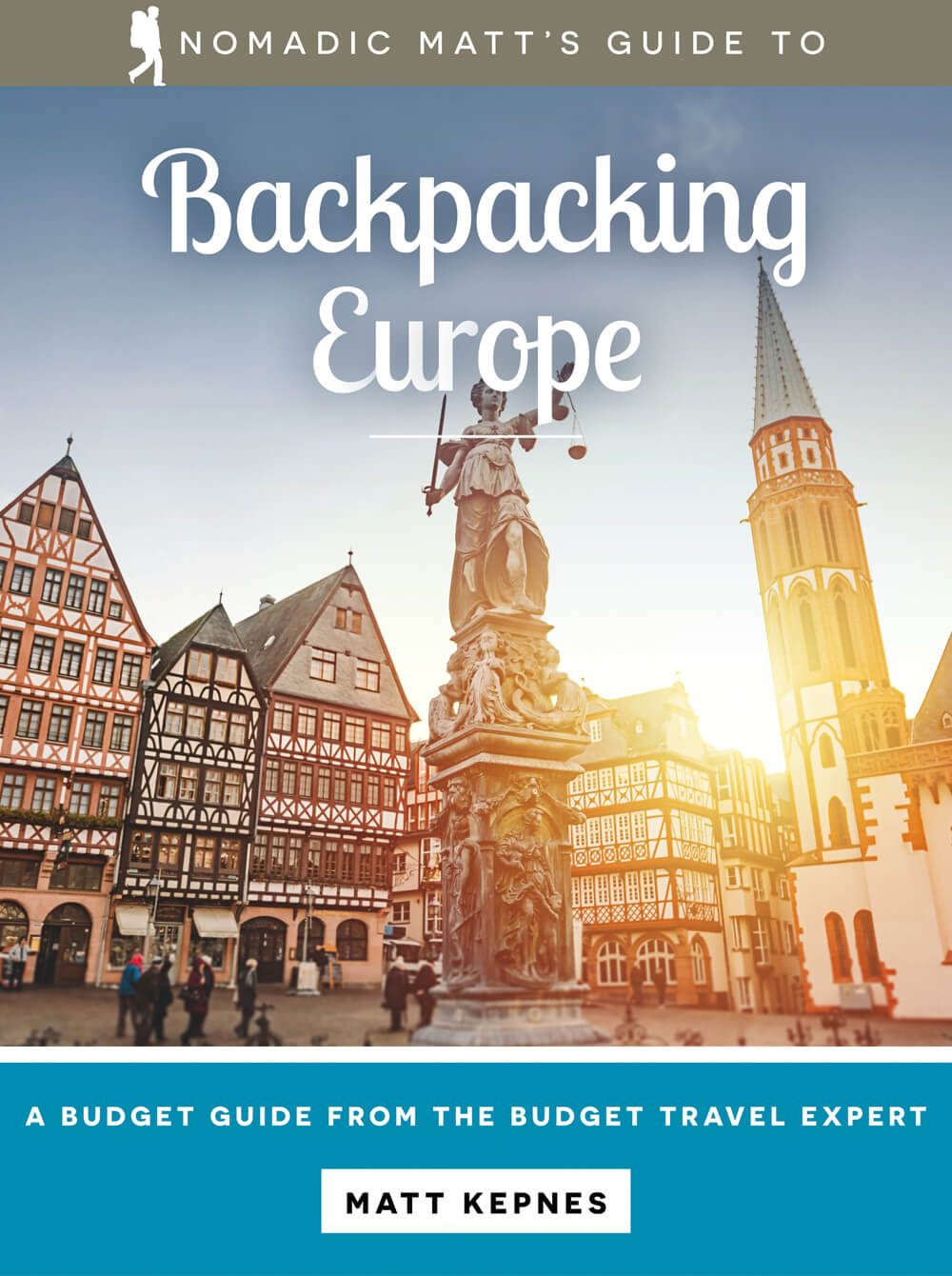
There’s a lot of free information online but do you want to spend days searching for information? Prob not! That’s why guidebooks exist.
While I have a lot of free tips on Europe, I also wrote an entire book that goes into great detail on everything you need to plan a trip here on a budget! You’ll get suggested itineraries, budgets, even more ways to save money, my favorite restaurants, prices, practical information (i.e. phone numbers, websites, prices, safety advice, etc etc), and cultural tips.
I’ll give the insider view of Europe that I got from years of traveling and living here! The downloadable guide can be used on your Kindle, iPad, phone, or computer so you can have it with you when you go.
Click here to learn more about my book on Europe!